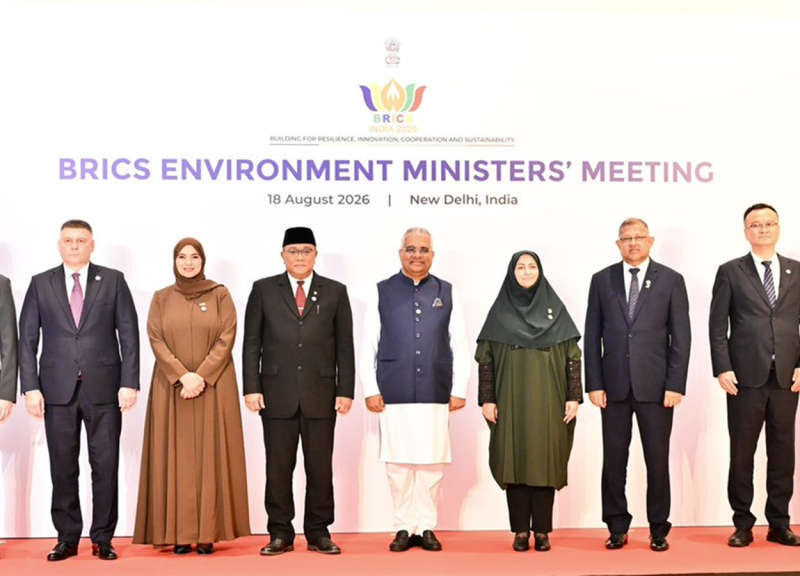
At the PHDCCI session on CBAM compliance and India’s industrial readiness, I had about three minutes. Panels are like that. What follows is what I would have said with more time, because the short version leaves out the part that actually decides outcomes.
Let me start where I started on stage.
CBAM is not a tariff we can lobby away. It is a price signal the world is converging on. The real question is not whether to decarbonise Indian steel and aluminium. It is whether India captures that value at home through our own carbon market, or exports it to Brussels as a cheque.
The state of play, in one honest sentence
The rules are real and the clock is ticking, but the bill is still small — and that gap is the opportunity.
CBAM’s definitive phase went live on 1 January 2026. Importers now buy and surrender CBAM certificates, and the first declaration, covering 2026 imports, is due 30 September 2027.
The charge this year is 2.5% of embedded emissions. It rises to 5% in 2027 and reaches 100% by 2034 as EU free allowances are withdrawn. That shape matters more than any single number: gentle, then steep. It is a runway, not a wall — but only if it is used as one.
- A 50-tonne de minimis threshold exempts roughly 182,000 small EU importers while keeping about 99% of emissions in scope. Relief for some small Indian shippers; none for the mills.
- Scope is widening. In June 2026 the EU agreed to extend CBAM to roughly 180 downstream steel- and aluminium-heavy products from 2028. Watch textiles.
- Certificate prices track the EU ETS, so India’s exposure rises with Europe’s carbon price, not with anything India controls.
For India this is overwhelmingly a steel and aluminium story. Steel alone is around 90% of our CBAM-exposed exports to Europe — and volumes are already down roughly a quarter year on year, before the real money is due.
India’s readiness — an honest scorecard
The gap. Blast-furnace-heavy steelmaking, roughly three-quarters coal-based. MSMEs with no plant-level MRV. A shortage of EU-accredited verifiers, which pushes exporters onto punitive default values.
The progress. The Carbon Credit Trading Scheme is live and building a genuine domestic compliance carbon price.
The cushion. A government scheme covering up to 90% of CBAM compliance costs for MSMEs.
The diplomacy. The India–EU FTA, concluded 27 January 2026, locks in an MFN clause, technical cooperation on carbon-price recognition and verifiers, and financial assistance.
But here is the nuance I want to be precise about, because it is usually stated wrongly — including, until I checked, on my own prep sheet.
Nine sectors are designated for transition into CCTS. GEI targets have been notified for seven. Iron and steel is not yet among them. MoEFCC put a draft amendment out on 26 June 2026 proposing to bring in 255 steel companies, with a sixty-day consultation.
So for the sector carrying about 90% of our CBAM exposure, there is not yet a notified domestic carbon price for Article 9 to recognise. The recognition problem is not only that the EU has not listed India. It is that, for steel specifically, we are still assembling the thing we want listed.
That is not a reason for despondency. It is a reason for sequencing.
Who actually carries the obligation
A point that gets lost constantly: legally, the obligation sits with the EU importer. They register as an Authorised Declarant, they buy and surrender the certificates, they file the declaration.
But the cost and the data burden flow straight back to the Indian producer, who must supply verified installation-level emissions or be priced on defaults.
CBAM readiness is therefore not a border problem. It is a plant-floor problem, upstream of the border, and it starts with measurement.
A worked example
Take an integrated BF-BOF mill exporting 10,000 tonnes a year of hot-rolled coil to a German buyer. All figures illustrative.
- Confirm scope and who declares. HRC is a listed CBAM good. Your German buyer is the Authorised Declarant. You are the operator who must supply emissions data. Do this now: fix in the sales contract who provides what, and who bears the certificate cost.
- Compute installation-level embedded emissions. Direct emissions (coke, sinter, blast furnace, BOF) plus relevant indirect (purchased power), attributed to HRC per the EU method. Say specific embedded emissions come out at 2.2 tCO₂ per tonne. That is 22,000 tCO₂ a year.
- Get it independently verified. An EU-accredited verifier checks that 2.2 figure. Skip this step and a default value lands — the worst-performer benchmark, 30–80% higher, perhaps 3.0+ tCO₂/t. You then pay on the inflated number.
- Import and register. The buyer logs the import in the CBAM Registry against your verified emissions.
- Buy certificates — and mind the ramp. At an ETS price around €80/t: in 2026, with a 2.5% factor and the free-allocation benchmark still deducted, the bill is a token few thousand euros. By 2034, at 100% and no free allocation: 22,000 × €80 ≈ €1.76 million a year, before any Article 9 credit.
- Annual declaration. The buyer files for 2026 imports by 30 September 2027.
- Surrender, minus the Article 9 credit. Surrender equals liability minus carbon price already paid in India. Today, with CCTS unrecognised, that deduction is zero.
- Close out. Keep verified data around four years. Gaps, under-surrender or unverified data trigger penalties and default-value reassessment.
Article 9, and why “just get recognition” is only half an answer
Article 9 lets an importer deduct a carbon price already paid in the country of production — provided that price is real, documented, and not subsequently rebated. It is the single most important lever for making a domestic carbon price count at the EU border.
India is not currently recognised. The EU’s draft implementing regulation of 13 May 2026 on carbon-price deductions names the United Kingdom, China and California. Not India.
Now the uncomfortable arithmetic. Even once recognised, an early CCTS price in the region of $10 a tonne sits far below an EU ETS price near $87. Recognition would shave a sliver off the bill. The bulk is still paid.
So recognition is necessary and not sufficient. It matters enormously — it decides whether carbon revenue stays in India or is remitted to the EU budget — but the price differential is the real economic exposure, and it narrows only as India’s own carbon price and sectoral coverage deepen credibly over time.
There is a second, more technical catch. CCTS is an intensity-based scheme. Converting an intensity obligation into a CBAM-legible “effective €/tCO₂ paid” is itself a methodological problem. That work has to be done before recognition is even negotiable.
Seven gaps between where we are and where we need to be
This is the part I most wanted to get to on the panel and did not. Each of these is a live piece of work, and most of them are being done by nobody in particular.
1. Installation-level data does not exist at the required granularity
CBAM wants emissions per installation, per good, verified. Most Indian plants have plant-level energy accounting and financial-year reporting, not product-level attributed emissions on a quarterly cycle. This is a metering, data-architecture and process problem long before it is a policy problem.
2. Verification capacity is thin, and unevenly thin
EU-accredited verification for CBAM, and domestic accredited verification for CCTS, are different pools with different accreditations. India has 15 Accredited Carbon Verification Agencies registered with BEE as at 14 July 2026 — but only five carry offset-mechanism accreditation, and only three of those are Final rather than provisional. If everyone needs verification in the same quarter, that queue is the binding constraint.
3. CCTS and CBAM speak different languages
Intensity targets versus absolute embedded emissions. Indian sectoral boundaries versus EU CN-code product boundaries. Someone has to write the crosswalk — the mapping that lets a CCTS-compliant dataset be reused for a CBAM declaration without a second, parallel measurement exercise. Until that exists, exporters do the work twice.
4. MSMEs in the supply chain are invisible
The large exporter is not the whole emissions footprint. Precursors, job-work, captive units and tier-2 suppliers all sit inside the embedded-emissions boundary, and almost none of them have the systems, the staff or the reason to measure. They also fall outside CCTS obligation, so no domestic driver pulls them along. This is the widest gap on the list.
5. Default values are a silent tax on the unprepared
Fail to supply verified data and you are assessed on worst-performer benchmarks. For a plant that is genuinely more efficient than the default assumes, the cost of not measuring is larger than the cost of measuring. Very few firms have run that number for themselves.
6. Article 9 recognition needs a technical case, not a diplomatic one
As above: converting an intensity-based obligation into a defensible effective carbon price, with documentation of what was actually paid and evidence that it was not rebated. That is analytical work. It has to exist before the negotiation is worth having.
7. Nobody owns the interface
Exporters, EU importers, verifiers, BEE, MoEFCC, the registry layer, standards bodies, technology vendors — each is doing a competent job of its own piece. The connective tissue is missing. This is the silo problem in its purest form: the opportunity is vast, the knowledge required is scattered, and the packaging is the work.
What an exporter should do on Monday
- Check your CN codes. Confirm which of your export lines are actually in scope, and whether the 50-tonne de minimis puts you outside the net entirely. Some firms are worrying about an obligation they do not have.
- Read your export contracts. Who supplies the emissions data, on what timetable, in what format, and who absorbs the certificate cost? If the contract is silent, that is a negotiation you want to have before 2027, not during it.
- Do a data-gap audit. Not a carbon audit — a data audit. What is metered, what is estimated, what is attributed to product, and what is simply not captured. Most of the eventual cost sits in what is not captured.
- Price the default. Estimate your real specific embedded emissions against the likely default value, and multiply the difference by your export tonnage and a plausible 2030 ETS price. That number is your measurement budget.
- Talk to your precursor suppliers now. Their data is inside your boundary. Getting it later is harder and more expensive than getting it now.
Three questions worth arguing about
I do not think these have settled answers yet. I would like to hear disagreement on all three.
- If CCTS recognition under Article 9 only removes a small fraction of the bill at today’s price gap, what is the actual strategic case for pursuing it urgently — revenue retention, precedent, or negotiating position?
- Should the crosswalk between CCTS data and CBAM declarations be built as public infrastructure, or left to commercial vendors? The first is slower; the second leaves MSMEs uncovered.
- Who pays for MSME measurement? They carry embedded emissions but no domestic obligation and no export contract. Large exporters benefit from their data. There is no mechanism that connects the two.
The line I keep coming back to
Measure it here, so it is trusted there.
That is the whole thesis in six words. Verified Indian emissions data, produced to a standard the EU cannot dismiss, is worth more than any amount of argument about whether the border adjustment is fair. The measurement is the negotiating position.
And it is worth saying plainly: none of this gets built by one organisation. Registries, verifiers, developers, funders, technology providers, industry associations and the ministries each hold one piece. The pieces are individually competent and collectively unconnected. Packaging them together is not a side activity. It is the actual bottleneck.
If you are working on any part of this — measurement systems, verification capacity, the CCTS-CBAM crosswalk, MSME data, or Article 9 — I would like to hear from you.
Disclosure. I am CEO of Carbon Registry India, a non-profit standard, and advise several organisations working in climate and ESG technology. The views here are my own and are written to be useful to the ecosystem as a whole rather than to any one participant in it. Where I have a commercial interest in a subject I say so in the piece. Figures are as verified on 25 August 2026; cost illustrations are indicative and not advice.
Related reading
- What is the Carbon Border Adjustment Mechanism (CBAM)?
- What is the EU Deforestation Regulation (EUDR)?
- India’s carbon market: a working reference — the structural overview these pieces sit inside
Get this in your inbox
I maintain a working reference on India’s carbon market — which CCTS sectors are notified, which are actually operable, how many methodologies and accredited verifiers exist, and where CBAM stands. Subscribe and I will tell you when those facts change. No fixed schedule, and nothing sent for the sake of sending it.