A working reference to how India’s carbon market is structured, what is usable today, and what is still being built. Last verified 25 August 2026 against the Bureau of Energy Efficiency’s Indian Carbon Market portal.
The information needed to answer one simple question — can this activity earn carbon credits in India? — sits across a scheme notification, rules under a separate Act, a sector memorandum, a methodology library, a verifier register, CERC regulations and a portal. This page holds them together.
How to read this page
Every claim below carries a source. I mark them so you can weigh them:
- [ICM] — verified directly against the official Indian Carbon Market portal on the date shown. Treat as authoritative.
- [Secondary] — from a credible third party such as ICAP or a ministry notification reported elsewhere, but not re-verified against the primary source. Treat with more caution.
- [EU] — from European Commission material.
If a figure matters to a decision you are making, follow the link and check it yourself. Where I got something wrong, it is recorded in the corrections log at the foot of this page.
First, three things that get conflated
Almost every confusion in this market traces back to treating these as one thing. They are not.
| Who takes part | How reductions are quantified | |
|---|---|---|
| CCTS compliance mechanism Government scheme, mandatory | Designated obligated entities in notified sectors. No choice. | No project methodologies. Greenhouse gas emission intensity targets, with a monitoring plan per entity. |
| CCTS offset mechanism Government scheme, voluntary to join | Non-obligated entities that choose to register a project. | Approved project methodologies — the twelve listed below. |
| International voluntary carbon market Not a government scheme | Anyone, via independent standards. | Those standards’ own methodologies. Nothing to do with CCTS. |
Two consequences worth holding onto:
- “Voluntary” here means voluntary to participate, not the voluntary carbon market. The CCTS offset mechanism is a government scheme. Credits issued under it are instruments of that scheme; they are not Verra, Gold Standard or any independent standard’s credits, and the two are not interchangeable.
- If you are an obligated entity looking for “the methodology for my sector”, there isn’t one. Compliance runs on intensity targets and monitoring plans, published under the compliance mechanism. The methodology library below is for offset projects only. [ICM, 25 Aug 2026]
What is published and usable today
Everything in this section is the offset mechanism.
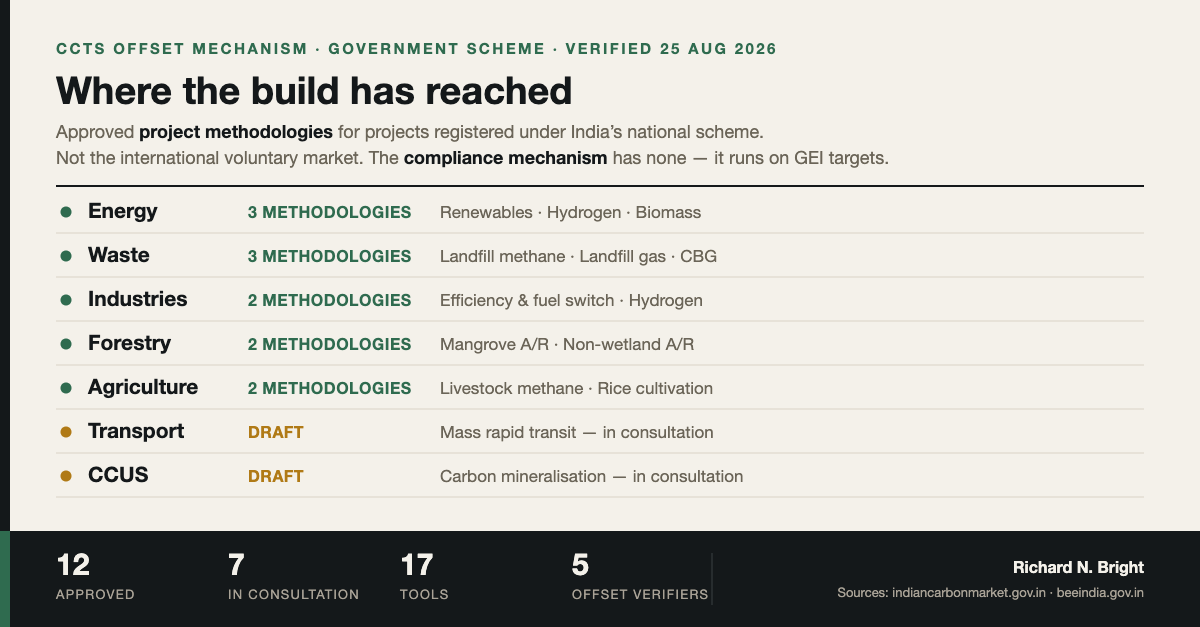
Twelve approved methodologies under the offset mechanism, covering five sectors. [ICM, 25 Aug 2026] — source
| Sector | Methodology | Number |
|---|---|---|
| Energy | Grid-connected electricity generation from renewable sources | BM EN01.001 |
| Energy | Hydrogen production from electrolysis of water | BM EN01.002 |
| Energy | Electricity and heat generation from biomass | BM EN01.003 |
| Industries | Energy efficiency and fuel switching for industrial facilities | BM IN02.001 |
| Industries | Hydrogen production using methane extracted from biogas | BM IN02.002 |
| Waste | Landfill methane recovery | BM WA03.001 |
| Waste | Flaring or use of landfill gas | BM WA03.002 |
| Waste | Production of Compressed Bio-gas (CBG) | BM WA03.003 |
| Forestry | A/R of degraded mangrove habitats | BM FR05.001 |
| Forestry | A/R of lands except wetlands | BM FR05.002 |
| Agriculture | Methane recovery from livestock and manure management | BM AG04.001 |
| Agriculture | Emission reduction through improved rice cultivation | BM AG04.002 |
Seventeen methodological tools are also published — twelve non-forestry (additionality, baselines, leakage, flaring, biomass, solid waste, composting) and five forestry (carbon stocks, dead wood and litter, soil organic carbon, displacement of pre-project activity). [ICM, 25 Aug 2026] — source
Detailed procedures are published for both the offset mechanism and the compliance mechanism, the latter including a monitoring plan instruction and template for obligated entities. [ICM, 25 Aug 2026]
If your activity maps to one of those twelve methodologies, you can proceed now. That is the most actionable sentence on this page.
What is in consultation — and why you should respond
Five methodologies are open for stakeholder input, with a comment template published alongside them. (BEE’s table has seven numbered rows; rows 4 and 7 are both the comment-input template, not a methodology.) [ICM, 25 Aug 2026] — source
- Emission reduction by shore-side electricity supply system — Energy
- Recovery and recycling of materials from end-of-life vehicles — Waste
- Mass Rapid Transit System — Transport (BM TR06.00X)
- Cooking energy — Energy
- Accelerated carbon mineralisation using reactive industrial waste — CCUS (BM CCUS10.001)
A methodology is written once and then governs project economics for a decade — baseline approach, monitoring burden, what counts as additional. If your sector appears above, responding to the consultation is probably the highest-return unpaid hour available to you in this market.
The two mechanisms
CCTS runs a compliance mechanism (greenhouse gas emission intensity targets for designated obligated entities, who earn or surrender Carbon Credit Certificates against them) and an offset mechanism (non-obligated entities register projects and earn credits for verified reductions). Each has its own detailed procedure on the portal. [ICM, 25 Aug 2026]
The two are administered separately, and the ACVA register lists compliance mechanism sectors and offset mechanism sectors as distinct columns for each accredited agency — so accreditation under one does not imply the other. [ICM, 25 Aug 2026] — source
Note added 25 Aug 2026: an earlier version of this page stated flatly that offset credits cannot be surrendered against a compliance obligation. That reflects my understanding of the scheme design, but I have not been able to verify it against a primary document, so I am no longer asserting it as established fact. Check the detailed procedures before building a business case either way — the distinction is material to whether offset supply can meet compliance demand.
Compliance sectors
Seven sectors carry notified greenhouse gas emission intensity targets, covering 490 obligated entities. Iron and steel is at draft stage. Fertiliser has not been notified. Targets are set at sub-sector level, use FY 2023–24 as the baseline, and bind for compliance years 2025–26 and 2026–27.
The 490 have never been published broken out by sector. Here they are. Counted row by row from the schedules of the two gazette notifications themselves.
| Sector | Obligated entities | Share | Notified | Instrument |
|---|---|---|---|---|
| Cement | 186 | 38.0% | 8 Oct 2025 | G.S.R. 739(E) |
| Textile | 173 | 35.3% | 13 Jan 2026 | G.S.R. 25(E) |
| Pulp and paper | 53 | 10.8% | 8 Oct 2025 | G.S.R. 739(E) |
| Chlor-alkali | 30 | 6.1% | 8 Oct 2025 | G.S.R. 739(E) |
| Petroleum refinery | 21 | 4.3% | 13 Jan 2026 | G.S.R. 25(E) |
| Aluminium — primary | 13 | 2.7% | 8 Oct 2025 | G.S.R. 739(E) |
| Petrochemicals | 11 | 2.2% | 13 Jan 2026 | G.S.R. 25(E) |
| Aluminium — secondary | 3 | 0.6% | 13 Jan 2026 | G.S.R. 25(E) |
| Total in force | 490 | 100% | ||
| Iron and steel | 255 proposed | — | draft, 26 Jun 2026 | G.S.R. 517(E), gazetted 2 Jul 2026 |
| Fertiliser | — | — | not notified | — |
[Primary — counted from the schedules of G.S.R. 739(E) and G.S.R. 25(E), downloaded from the Indian Carbon Market portal. The two batch subtotals reconcile exactly to the figures PIB published: October 2025 gives 186+53+30+13 = 282, January 2026 gives 173+21+11+3 = 208. That reconciliation is the check that the count is right rather than merely plausible. Anyone can repeat it: each schedule row carries a serial number and a registration code of the form CMTOE001KA, TXTOE060TN, CNAOE030GJ — count the serial numbers, not the codes.]
Textile is the second-largest sector in the compliance scheme by entity count, and it is almost invisible in the coverage. Cement and aluminium dominate the commentary because they are the emissions-heavy sectors and the CBAM-exposed ones. But by number of companies that must now measure, verify and report an emission intensity against a legal target, cement and textile together are 73% of the entire scheme — and textile alone outnumbers pulp and paper, chlor-alkali, refining, aluminium and petrochemicals combined. Sixty of the 173 textile entities are spinning units. The typical CCTS-obligated entity is not a large integrated industrial group with an existing energy-management function. It is a spinning mill.
Where the “740 entities across nine sectors” figure comes from
It circulates widely and it is not a notification count. Reconstructed, it is 490 in force plus the 255 proposed for steel = 745, which is close to 740 and is a description of a scheme that does not exist yet. And “nine sectors” is BEE’s own scoping list, whose wording is that those sectors are to be considered for gradual transition — a shortlist, not a set of notifications.
Showing how the number is produced is more useful than contradicting it. If you see 740, or 745, or nine sectors, the writer has added a draft to a notification.
Iron and steel — the largest block, still a draft
The draft Third Schedule, G.S.R. 517(E), is dated 26 June 2026 and was gazetted on 2 July 2026. The 60-day comment window therefore closed on 31 August 2026, not in late August as several summaries have it — the clock runs from gazette publication, not from the document’s face date. It has not been notified since.
| Measure | Draft schedule |
|---|---|
| Entities listed | 255 |
| Combined baseline emissions, FY 2023–24 | 358.6 MtCO₂e |
| Implied reduction, 2026–27 | 20.0 MtCO₂e (5.59%) |
| Target for 2025–26 | Empty for all 255 rows |
[Primary — parsed row by row from G.S.R. 517(E). Counted by serial number: counting by registration code gives 256, because INSOE0020 does not appear in the schedule.]
Two things follow. Steel’s baseline alone is larger than the notified sectors carry between them, so until it is notified the compliance market is missing its largest participant. And the draft sets no target at all for 2025–26 — the column is blank for every one of the 255 rows. Whatever steel is eventually asked to do, it is not being asked to do it in the first compliance year.
What has not happened
This is the part no other reference states plainly, so it is stated plainly here.
| Expected | Source and date | Position at 7 September 2026 |
|---|---|---|
| First carbon credit certificate trading “by mid-2026” | ICAP, 30 Mar 2026 | No trading reported. Mid-2026 has passed. |
| Iron and steel final notification | draft 26 Jun 2026, window closed 31 Aug 2026 | No final notification found as of 7 Sep 2026. |
| Fertiliser targets | expected “by year-end” 2025 | Still not notified. |
| Registered offset projects | registry live | Register displayed no entries when read on 2 Sep 2026. |
The architecture is complete. The Indian Carbon Market Portal launched on 21 March 2026. The trading rulebook exists — CERC’s Terms and Conditions for Purchase and Sale of Carbon Credit Certificates Regulations, 2026, Gazette No. 292, notified 27 April 2026. Fifteen agencies are accredited to verify, eleven of them for the compliance mechanism. Twelve methodologies are approved and five more are in consultation. And nothing has traded.
[Primary for the CERC date — the Commission’s own register of regulations in force, entry 205. Four independent secondary sources give 27 February 2026 and are all wrong by two months. Agreement among secondary sources is not corroboration.]
That gap — between a scheme that is fully built and a scheme that is running — is the single most useful thing to know about India’s carbon market in September 2026, and it is the thing the official material is least likely to tell you. Dates on this page are the dates things were published, not the dates they took effect, because in several cases they have not taken effect.
Compliance sectors monitored since 26 Aug 2026. Counts last verified against the gazette schedules 2–4 Sep 2026. Section last checked 7 Sep 2026.
Verification capacity
The ACVA register is maintained by BEE, not on the ICM portal, and it is the authoritative list: List of Accredited Carbon Verification Agency empanelled under CCTS. 15 agencies are empanelled (ACVA001–ACVA015), register last updated 14 July 2026. [BEE, retrieved 25 Aug 2026]
Accreditation is granted per mechanism and per sector, and is either Provisional (one year) or Final (five years). That structure is what matters for planning, not the headline count.
Accredited for the offset mechanism — 5 of the 15
| Agency | Cert. | Status | Valid to | Offset sectors |
|---|---|---|---|---|
| Bureau Veritas India | ACVA002 | Final | 02-03-2031 | Energy · Industries · Waste · Agriculture · Forestry · Transport · Fugitive Emission |
| TUV India | ACVA003 | Final | 16-04-2031 | Industries · Agriculture · Transport |
| KBS Certification Services | ACVA006 | Final | 16-04-2031 | Energy · Industries · Waste · Agriculture · Forestry · Transport · Fugitive Emission |
| VKU Certification | ACVA001 | Provisional | 02-03-2027 | Energy · Industries · Waste · Agriculture · Forestry |
| Earthood Services | ACVA004 | Provisional | 16-04-2027 | Energy · Industries · Waste · Agriculture · Forestry |
Note: Bureau Veritas and KBS are accredited for seven offset sectors each, including Transport and Fugitive Emission — both of which are sectors where accreditation currently runs ahead of an approved methodology. Verifiers are accredited for more sectors than a project can presently use.
Three hold Final accreditation, two Provisional. Bureau Veritas is accredited for both mechanisms. Note that TUV India is the only agency accredited for Transport offset projects — a sector whose methodology is still in consultation, so accreditation is running ahead of the methodology there.
Accredited for the compliance mechanism — 11 of the 15
Bureau Veritas (Final, both mechanisms) plus ten provisionally accredited agencies: PGS Energy Services, Encon Sustainability, Energy Audit Services, Operative Save Urja Solution, Eco Energy Solution, FICCI, Namdhari ECO Energies, East Coast Sustainable, NIN Energy India, and the Confederation of Indian Industry. Sector coverage varies by agency and includes aluminium, cement, chlor-alkali, iron and steel, petrochemical, petroleum refinery, pulp and paper, textile and fertilizer.
Two things stand out. Capacity has grown quickly — the register ran from ACVA001 in March 2026 to ACVA015 by late June 2026. And compliance verification is being built out faster than offset verification, which follows the sequencing: obligated entities have deadlines, offset projects do not.
Recommendation: check the register for your specific mechanism and sector before building a timeline. An agency accredited for compliance in your sector cannot necessarily verify your offset project, and most current accreditations are Provisional with one-year validity — so confirm the agency you plan to use is still accredited when you need them.
The trading layer
CERC has published the Terms and Conditions for Purchase and Sale of Carbon Credit Regulations, 2026. The power exchanges named on the portal are IEX, HPX and PXIL. [ICM, 25 Aug 2026] — source
Public registers: what is and is not populated yet
This matters for anyone sizing the market, so it is worth stating precisely. As at 25 August 2026: [ICM]
| Register | State |
|---|---|
| Registered Projects | No entries yet |
| Listed Projects | One entry, open for stakeholder consultation |
| Statistics | Marked “Coming Soon” |
| Article 6 | Marked “Coming Soon” |
The portal homepage separately displays two counters, Compliance Registrations and Offset Registrations, without a label describing what they count. Given that the Registered Projects register is not yet populated, these should not be read as project counts, and I would not use them for market sizing. If you need project-level data for diligence, ask BEE directly. [ICM, 25 Aug 2026]
Bringing public registers online in stages is normal for infrastructure this new — procedures, methodologies and tools first, project data as projects arrive.
Article 6
India has authorised a small number of activities for international cooperation under Article 6 of the Paris Agreement; authorisation carries corresponding adjustment obligations, which is why the list is deliberately short. The portal’s Article 6 section is marked “Coming Soon” as at 25 August 2026, so I am not quoting a count here. [Secondary; portal section not yet live]
Where CBAM meets this
CBAM’s definitive phase began 1 January 2026, with the first annual declaration covering 2026 imports due 30 September 2027. The charge rises from a low share of embedded emissions to 100% by 2034 as EU free allocation is withdrawn, and consignments under 50 tonnes a year fall outside it. [EU — European Commission CBAM material; not re-verified today]
Article 9 lets an importer deduct a carbon price already paid in the country of production. The EU’s draft implementing regulation of 13 May 2026 names the United Kingdom, China and California. India is not currently on that list. [EU — draft implementing regulation; not re-verified today]
Two structural points follow. CCTS is intensity-based, so converting an intensity obligation into a CBAM-legible effective price per tonne is itself unresolved. And recognition removes part of the bill rather than most of it while the domestic and EU prices remain far apart.
Practical consequence: do not wait for recognition to start measuring. Absent verified installation-level data, CBAM assesses you on default values pegged to worst-performer benchmarks — so if you are more efficient than the default assumes, not measuring costs you money immediately, whatever happens with Article 9. Full analysis: CBAM: India’s problem is a data problem before it is a carbon problem.
Start here
- Can your project become a carbon project in India? A practical test
- What qualifies as a carbon project?
- What is a carbon methodology?
- Additionality in carbon offsets: why it matters
- How to create carbon project documentation (PDD)
Sources
Primary. The Bureau of Energy Efficiency’s Indian Carbon Market portal is the authoritative source for everything on this page marked [ICM], and should be your first stop for anything official:
- indiancarbonmarket.gov.in — the portal
- Offset mechanism — procedures, approved methodologies, methodologies in consultation, tools
- Compliance mechanism — procedures, monitoring plan instruction and template
- ACVA register — accredited verification agencies by mechanism and sector
- List of Accredited Carbon Verification Agency empanelled under CCTS — BEE’s register, the authoritative list (HTML; a PDF version also exists but read the HTML)
- ACV Agency accreditation — application form, procedure and eligibility criteria, applications open
- Regulations — CERC trading regulations
- Listed projects and registered projects
Secondary. Where the portal does not yet publish something, I have used the ICAP ETS Map for India, reporting on MoEFCC notifications and draft amendments, and European Commission material for CBAM. These are marked [Secondary] or [EU] inline. They are credible but they are not the primary record, and I say so rather than blurring the difference.
Where I am not quoting a number at all, it is because I could not source it primarily and did not think a secondary figure was worth the risk of being wrong. That will change as the portal’s registers come online.
Corrections log
This page is maintained, which means it is sometimes wrong and then fixed. Everything corrected is recorded here rather than quietly edited.
| Date | Correction |
|---|---|
| 25 Aug 2026 | Carbon capture. Earlier text said CCUS had neither an approved methodology nor an accredited verifier. Incorrect — a draft methodology (BM CCUS10.001, accelerated carbon mineralisation using reactive industrial waste) is open for stakeholder consultation. Corrected. |
| 26 Aug 2026 | Offset sector coverage for two agencies. This table listed Bureau Veritas (ACVA002) and KBS Certification (ACVA006) as accredited for five offset sectors. Both are accredited for seven, including Transport and Fugitive Emission — an earlier read truncated the register’s sector column. Caught by the automated monitoring extractor on its first run, which is the point of it. |
| 25 Aug 2026 | Verification agency counts — corrected twice in one day. This page first said 15 agencies with 5 offset-accredited and 3 Final. I then “corrected” that to 2 agencies after an automated read of BEE’s PDF returned only the first two rows. The original figures were right. BEE’s HTML register, last updated 14 July 2026, lists 15 agencies (ACVA001–ACVA015): 5 accredited for the offset mechanism, of which 3 hold Final accreditation. Restored and expanded with the full breakdown. The lesson, recorded here because it is the useful part: a truncated extract is more dangerous than no data, because it looks like data. |
| 25 Aug 2026 | Offset credits and compliance. Earlier text asserted that offset credits cannot be surrendered against a compliance obligation. Downgraded to an open question pending a primary source. |
| 25 Aug 2026 | Obligated entity count. Earlier text quoted a figure for entities carrying an obligation. Removed pending primary verification. |
| 25 Aug 2026 | Sourcing. Every claim now carries a source marker and date. Prompted by a reader pointing out that the official portal existed and I had not cited it. |
| 7 Sep 2026 | Obligated entities — the section now quotes a number, and quotes it per sector. It previously declined to give a figure, on the grounds that the published counts were secondary. They have since been counted row by row from the schedules of G.S.R. 739(E) and G.S.R. 25(E), and the two batch subtotals reconcile exactly to the 282 and 208 that PIB published. 490 in seven sectors: cement 186, textile 173, pulp and paper 53, chlor-alkali 30, refinery 21, aluminium 16, petrochemicals 11. |
| 7 Sep 2026 | The January 2026 notification covers four sectors, not three. This page named petroleum refining, petrochemicals and textiles. G.S.R. 25(E) also notifies secondary aluminium (3 entities, ALMOE014–016). ICAP’s update makes the same omission; most coverage has copied it. Also settled from the gazette face: G.S.R. 25(E) is dated 13 January 2026, where ICAP gives 16 January. |
| 7 Sep 2026 | “Seven methodologies are open for consultation” — five are. BEE’s consultation table has seven numbered rows, but rows 4 and 7 are both the comment-input template rather than a methodology. The list on this page was already right; the sentence above it was not. |
Maintained by Richard N. Bright. I am CEO of Carbon Registry India, a non-profit carbon standard and an initiative of NCCF, and I advise organisations working in climate and ESG technology. This page is written for the ecosystem rather than for any one participant in it; where I have a commercial interest in a subject I say so. Corrections are welcome and credited — if a figure here has moved or is wrong, tell me and it goes in the log above.
Get this in your inbox
I maintain a working reference on India’s carbon market — which CCTS sectors are notified, which are actually operable, how many methodologies and accredited verifiers exist, and where CBAM stands. Subscribe and I will tell you when those facts change. No fixed schedule, and nothing sent for the sake of sending it.