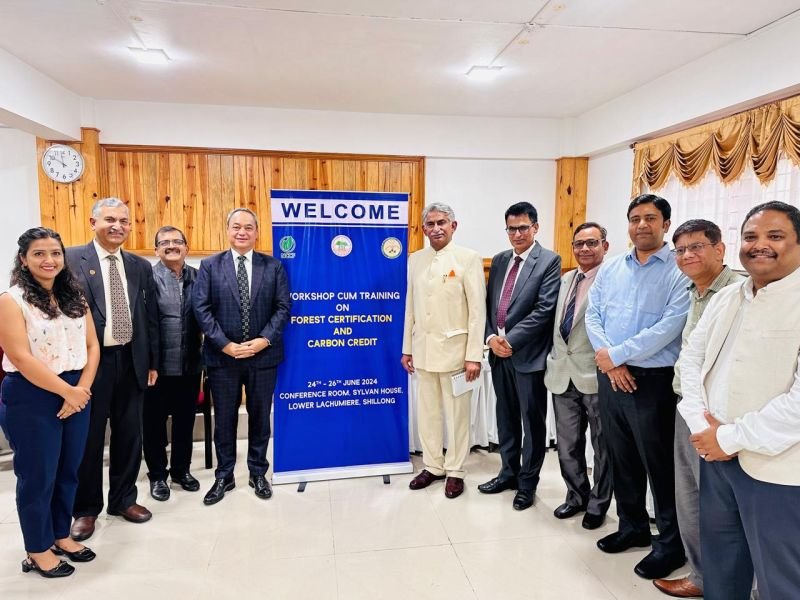
My first visit to Meghalaya came at exactly the right time. Delhi had become unbearable, 48 to 50 degrees. Shillong offered 24 to 25 degrees, intermittent rain and an AQI below 25. Walking through old-growth forest and breathing pine-scented air after that summer was its own argument for the work.
The reason for the trip was a multi-day workshop on forest certification and carbon credits, held at Sylvan House in Shillong from 24 to 26 June, jointly organised by the Meghalaya Forest Department and the Network for Certification and Conservation of Forests (NCCF).
The part that actually matters
Most coverage of an event like this stops at the fact that it happened. The substantive shift is in the objective, which was not to explain carbon markets to a forest department so that it could host projects run by other people. It was to build the capacity for the forest department to develop and register its own carbon projects.
That is a different proposition, and I do not think its implications are widely appreciated.
State forest departments control very large areas of land. They already run the institutional machinery a carbon project needs and that private developers spend years building from nothing: boundary records, working plans, decades of management data, field staff, and an established relationship with the communities living in and around the forest. On paper they are better positioned to originate credible projects than almost anyone else in the country.
What they have not typically had is the specific competence carbon markets demand — baseline setting, additionality argumentation, methodology selection, monitoring design, the documentation a validator will accept, and a working understanding of what happens between listing and issuance. That is a training problem, not a structural one. Which makes it solvable, and cheap relative to the asset base involved.
The alternative model, where a department signs land over to an external developer on terms it is not equipped to evaluate, has not served state governments particularly well anywhere. Capacity is the better answer.
Trees outside forests
One session covered the Trees Outside Forests (TOF) standard, and it deserves more attention than it gets.
A great deal of India’s tree cover is not in notified forest. It sits on farm bunds, along canals and roads, in homestead groves and block plantations on private land. Carbon frameworks built around contiguous forest blocks handle this badly, and the people who own those trees — overwhelmingly smallholders — are exactly the people least able to navigate a carbon methodology on their own. If the accounting only works for large contiguous parcels, an enormous amount of genuine sequestration stays outside the system, and the benefit never reaches the person who planted the tree.
Aggregation is the hard part, and it is unsolved. But the category has to exist in the standards before anyone can work on it.
Certification and carbon markets are converging
Sessions also covered the integration of forest certification with carbon markets, and the link to the EU Deforestation Regulation.
These used to be separate conversations. Certification was about sustainable management and market access for timber and non-timber products. Carbon was about tonnes. They are converging because both now rest on the same underlying requirement: defensible, geolocated, independently verified evidence about a specific piece of land over time. EUDR asks for proof that a commodity is not linked to deforestation. A carbon methodology asks for proof that a reduction is real and additional. The evidence base is largely shared.
An organisation that builds that evidence base once can serve both. One that treats them as separate compliance exercises will pay for the same measurement twice.
With thanks
My thanks to Chief Secretary Shri Donald Phillips Wahlang, IAS; Commissioner & Secretary Shri Pravin Bakshi, IAS; PCCF & HoFF Meghalaya Shri Ranjit Singh Gill, IFS; and PCCF WP, R&T, DCA Meghalaya Shri H. C. Choudhary, IFS, for setting the precedent for this initiative and for the opportunity.
The expert delegation was led by Mr A. M. Singh, IFS, Director General of NCCF and former PCCF & HoFF Assam, who also gave the master class on the Trees Outside Forests standard. Dr Devendra Pandey, IFS, former Director General of the Forest Survey of India and former PCCF (HoFF) Arunachal Pradesh, and Mr Avani Varma, IFS, former PCCF & HoFF Karnataka, contributed sessions, alongside Ms Abhilasha Guleria of NCCF and Mr Aniruddh Soni and Mr Varun Grover of TERI. A considerable amount of collective field experience in one room.
And a genuine thank you to the Meghalaya Forest Department team and the NCCF secretariat, Mohit Kumar and Ritika Bhardwaj, who made it work.
Looking back at this
I am publishing this to the blog well after the fact, as part of bringing the record here up to date. Two years on, the question it raised has not gone away and has arguably sharpened: who is actually equipped to originate carbon projects in India at scale?
The answer still cannot be "private developers alone". There are not enough of them, verification capacity is thin, and the land that matters most is largely under public or community control. Building capacity inside the institutions that already hold the land and the data remains, to me, the most direct route available.
Related reading
- What are nature-based solutions (NBS)?
- REDD+ as a carbon project: pros and cons
- What is the EU Deforestation Regulation (EUDR)?
- Piplantri: what a village teaches about climate impact
- India’s carbon market: a working reference — the structural overview these pieces sit inside
Disclosure. This workshop was co-organised by NCCF. Carbon Registry India, where I am Chief Executive Officer, is an initiative of NCCF, so I have a direct institutional interest in the certification and registry work described here. Read it with that in mind. The argument about forest department capacity is one I would make regardless, and it does not depend on which registry a department chooses to use.
Get this in your inbox
I maintain a working reference on India’s carbon market — which CCTS sectors are notified, which are actually operable, how many methodologies and accredited verifiers exist, and where CBAM stands. Subscribe and I will tell you when those facts change. No fixed schedule, and nothing sent for the sake of sending it.
One thought on “Meghalaya: when a forest department becomes a carbon project developer”