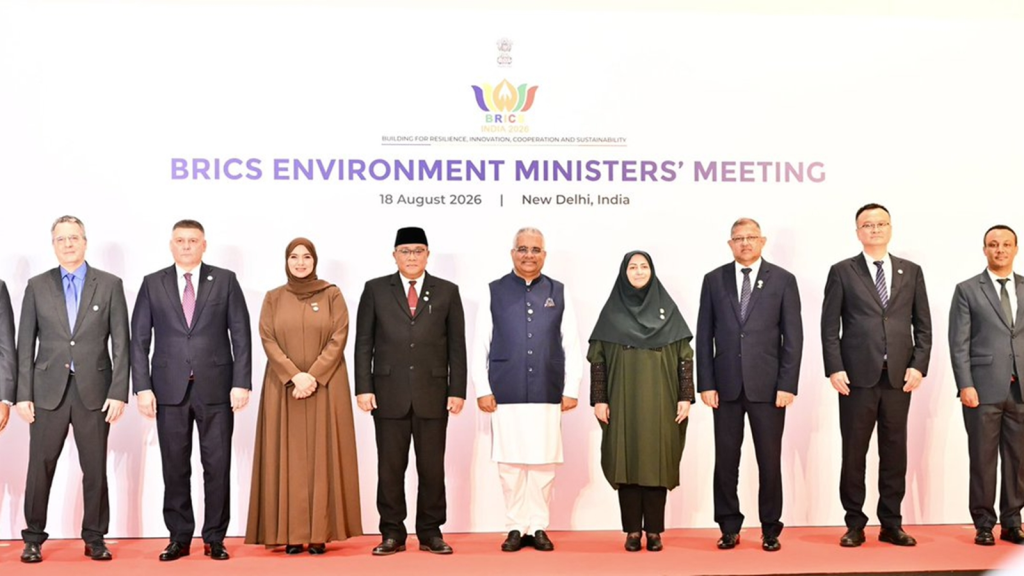
On 12 September 2026 the BRICS leaders said in New Delhi that they “look forward to the implementation” of the Memorandum of Understanding on the BRICS Carbon Markets Partnership. Three weeks earlier, the ministers who actually own that file had already stopped writing about it. The Joint Statement of the 12th BRICS Environment Ministers’ Meeting, adopted in New Delhi on 18 August 2026, contains the phrase “Article 6” zero times and the phrase “Carbon Markets Partnership” zero times. India’s own factsheet of what its chairship delivered, published 11 September 2026, contains the word “carbon” zero times.
The ministerial dropped it before the leaders did
The Environment Ministers’ track sits under the Contact Group on Climate Change and Sustainable Development, which is the body the leaders’ declaration names as responsible for this agenda. Its 18 August 2026 joint statement runs to 32 pages. Term counts across the full document, annexes included, read on 16 September 2026:
| Term | Occurrences, 12th Env Ministers, 18 Aug 2026 |
|---|---|
| Article 6 | 0 |
| Carbon Markets Partnership | 0 |
| carbon market(s) | 1 |
| carbon credit | 0 |
| emissions trading | 0 |
| carbon pricing | 0 |
| carbon border adjustment / CBAM | 1 / 1 |
| adaptation | 65 |
The single surviving mention of carbon markets is not a commitment and not a work programme. It is the name of a dialogue, and it is subordinated to adaptation. Paragraph 35:
We appreciate knowledge sharing through the BRICS High-level Dialogue on People-Centric Community-based Adaptation Approaches and the Dialogue on Aligning Carbon Markets with Adaptation Goals.
Joint Statement of the 12th BRICS Environment Ministers’ Meeting, New Delhi, 18 August 2026, para 35
Sixty-five mentions of adaptation against one of carbon markets, in the document that owns the file. That ratio is the whole finding. The leaders’ declaration three weeks later still named the Partnership once; the ministerial that would have to implement it did not name it at all.
India’s own outcomes factsheet has no carbon in it
The BRICS India 2026 Factsheet on Outcomes and Initiatives under India’s Chairship, published 11 September 2026, is the chairship’s own enumeration of what it delivered, organised into four pillars — one of which is sustainability, covering climate action, environmental stewardship, circular economy and green transition. The word “carbon” appears zero times in its 14 pages. “Climate” appears seven times.
Four outcomes are listed under the Environment track:
- BRICS Principles for Advancing Climate Resilience through People-Centric and Community-Based Adaptation Built on Traditional Knowledge
- BRICS Principles for Integrated Landscape Management for Combating Desertification, Sustainable Land Management and Ecosystem Resilience
- Common Understanding for Forest Fire Preparedness and Response across BRICS
- Terms of Reference on a Network of BRICS Institutions to Advance Knowledge Sharing, Research & Innovation in Sustainable Lifestyles
The BRICS Carbon Markets Partnership is not among them. Neither is any other carbon-market item. The factsheet was published on 11 September. The next day, the leaders said they look forward to implementing the Partnership it does not mention.
Where Article 6 actually went
The deletion is a 2026 event, and it is worth being precise about that because the obvious reading — that carbon markets quietly faded after Kazan — is wrong. Article 6 of the Paris Agreement was named at Kazan on 23 October 2024. It was still there at Rio de Janeiro on 6 July 2025, where leaders acknowledged it directly as “an important instrument for fostering higher ambition in mitigation actions”. It is absent from the entire New Delhi Declaration of 12 September 2026. It is absent from the environment ministerial of 18 August 2026. Both of those documents were adopted under India’s chairship, in New Delhi.
The MoU verb tells the same story in reverse. Rio already said “look forward to its implementation” in July 2025. New Delhi said it again in September 2026. That is not a softening; it is the same holding formula, frozen for 434 days across two chairmanships.
What this means if you are selling Indian credits
- There is still no BRICS mechanism for transferring carbon credits between members. The Partnership is a knowledge-sharing platform, and the ministerial that would have to build anything more has stopped writing about it.
- Article 6 was the only part of this agenda that could have created foreign demand for Indian credits. It is the mechanism under which one country’s credits count toward another’s NDC. It is gone from both 2026 texts.
- What replaced it is adaptation. The surviving carbon-markets item is a dialogue about aligning carbon markets with adaptation goals. That is a legitimate agenda and it is not a demand signal.
- Your CBAM exposure is unchanged. The ministerial objects to carbon border adjustment mechanisms once. That is a position, not an instrument, and it has changed no importing country’s law.
The MoU itself has still never been published
Twenty-three months after adoption at Kazan, the text of the Memorandum of Understanding remains unavailable to the practitioners expected to work under it. Checked again on 16 September 2026 against the chairship’s own register at brics2026.gov.in, which runs from 2010 to 2026 and does publish memoranda of understanding. There is no Carbon Markets Partnership MoU in it. If a reader has a copy, we will publish the correction.
Method
Every count above was re-derived on 16 September 2026 from the PDFs on the chairship’s own register, with whitespace collapsed and soft hyphens stripped before matching. That step matters: these documents are justified text, and a naive extractor splits multi-word phrases across runs of spaces — “Carbon Markets” — so whitespace-sensitive matching silently under-counts every multi-word term and can turn a real mention into a false zero. An earlier pass on this desk did exactly that. Counts are case-insensitive and whole-document, annexes included.
Sources
All primary. No news report is relied on for any claim above.
- Joint Statement of the 12th BRICS Environment Ministers’ Meeting, New Delhi, 18 August 2026 — brics2026.gov.in archival database, 32 pages.
- BRICS India 2026 Factsheet on Outcomes and Initiatives under India’s Chairship, 11 September 2026 — brics2026.gov.in archival database, 14 pages.
- BRICS New Delhi Declaration, 18th BRICS Summit, 12 September 2026 — brics2026.gov.in; cross-checked against pmindia.gov.in.
- BRICS Rio de Janeiro Declaration, 17th BRICS Summit, 6 July 2025 — Press Information Bureau, Government of India, PRID 2142786.
- XVI BRICS Summit Kazan Declaration, 23 October 2024 — Department of International Relations and Cooperation, Republic of South Africa, para 85.
Get this in your inbox
I maintain a working reference on India’s carbon market — which CCTS sectors are notified, which are actually operable, how many methodologies and accredited verifiers exist, and where CBAM stands. Subscribe and I will tell you when those facts change. No fixed schedule, and nothing sent for the sake of sending it.