A year ago, nearly 70,000 people marched through Belém in what some called a funeral for coal, oil and gas. Brazil billed COP30 as the implementation COP. Twelve months later the circus has moved to the Mediterranean coast, and the question has not changed much. It has just become harder to dodge.
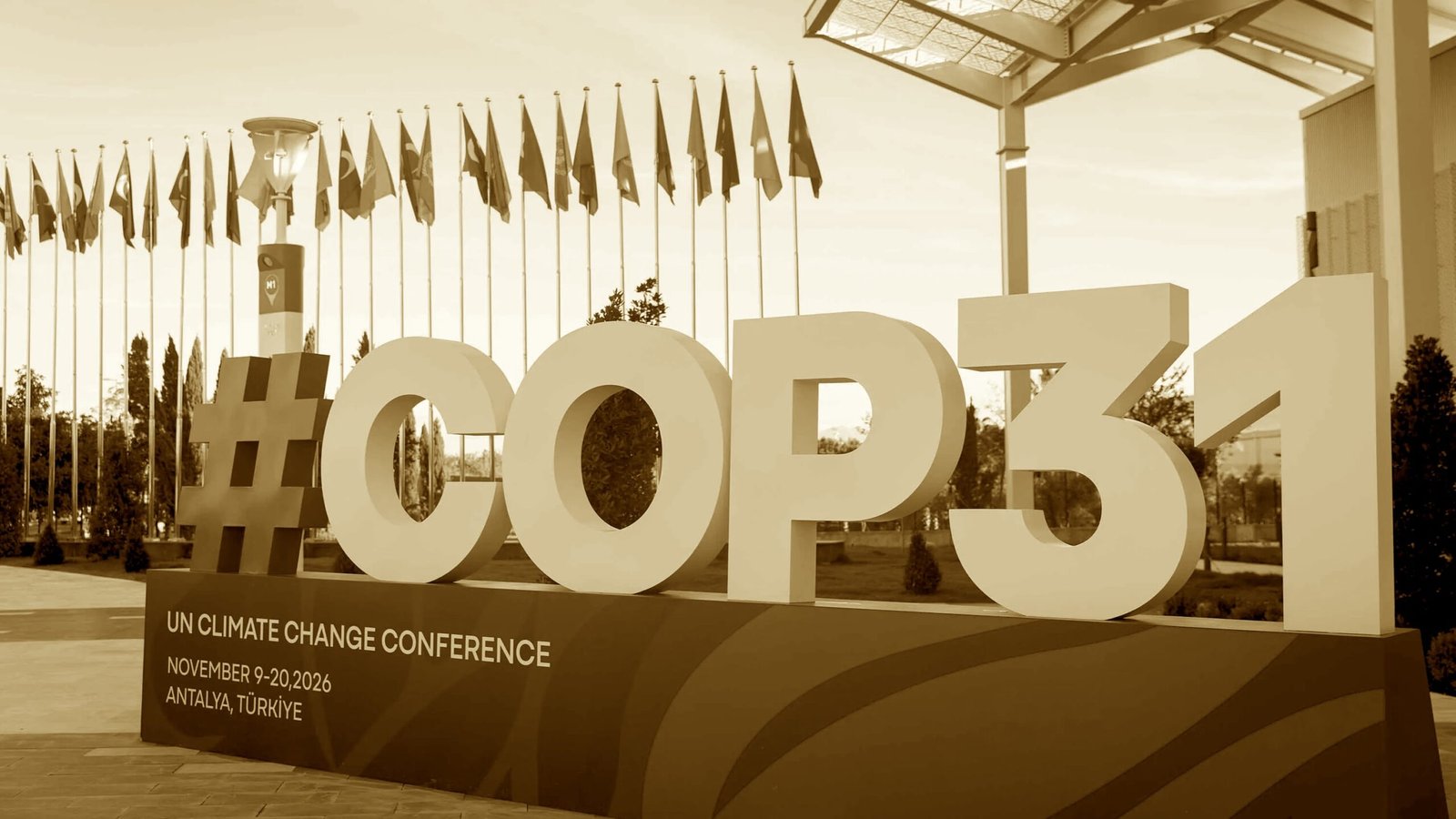
COP31 opened in Antalya on 9 November and runs until 20 November. Close to 200 countries are here, and organisers expect more than 90,000 people. It is also an odd arrangement. Türkiye and Australia both wanted to host, neither would back down, and the compromise struck in Belém gave each a piece. Türkiye’s environment minister, Murat Kurum, holds the gavel as COP President and runs the Action Agenda. Australia’s climate minister, Chris Bowen, chairs the formal negotiations. The Pacific got the pre-COP, held in Fiji in early October with a leaders’ event in Tuvalu.
Simon Stiell opened the conference by saying progress is “nowhere near far enough or fair enough.” He also warned that “no COP is a silver bullet.” Both are true, and both have been true for a while. What makes Antalya different is the arithmetic. Ten years after Paris, the bills on several old promises are now due, and the latest science says we have already missed the cleanest route to 1.5°C.
I come at COPs from an odd angle. Before carbon markets, I spent three decades in enterprise technology, managing global software operations and delivering the ERP and CRM platforms that run some of the world’s largest organisations, particularly financial institutions, while strengthening the governance, compliance and risk controls that keep their books honest. Today I work across the carbon market as a practitioner, on methodology development, MRV and remote sensing, registry operations, ESG advisory and training the people who will run all of it. So when I read a COP decision, my first question isn’t whether the language is ambitious. With more registries in play than ever, it’s whether the decision will work across all of them. Can a tonne be measured, recorded and audited, then reconciled between project registries, national accounts and the UN’s books, without being counted twice?
That lens shapes this piece. It looks back at what was promised and what got delivered, at what slipped through the cracks, and at what Antalya can realistically close. Then it asks what any of it means for India.
The road to Antalya
Every COP gets sold as historic. A handful actually were, and they explain most of what is on the table this fortnight.
| COP | Year | What it promised | How it has held up |
|---|---|---|---|
| COP3, Kyoto | 1997 | Binding cuts for rich countries; birth of the CDM | The US never ratified. The CDM built a carbon market and a lot of its integrity problems |
| COP15, Copenhagen | 2009 | $100 billion a year in climate finance by 2020 | Met in 2022 by the OECD’s count, two years late and largely as loans |
| COP21, Paris | 2015 | Well below 2°C, pursue 1.5°C; national pledges ratcheted every five years | The framework survived. The ambition inside it has not caught up |
| COP26, Glasgow | 2021 | Article 6 rulebook; coal “phase down”; double adaptation finance by 2025 | Rulebook done. Adaptation finance still far short of need |
| COP27, Sharm el-Sheikh | 2022 | A fund for loss and damage | Created, but pledges sit well under $1 billion against losses counted in hundreds of billions |
| COP28, Dubai | 2023 | First Global Stocktake; “transition away from fossil fuels”; triple renewables, double efficiency by 2030 | Renewables are racing ahead. The fossil language has never been turned into a plan |
| COP29, Baku | 2024 | New finance goal (NCQG) of $300 billion a year by 2035, with a call to reach $1.3 trillion; Article 6 rules finished | Developing countries called $300 billion an insult. The $1.3 trillion has no owner |
| COP30, Belém | 2025 | Global Mutirão decision; triple adaptation finance by 2035; 59 adaptation indicators; a just transition mechanism | Fossil fuel roadmap dropped from the formal text. Several big pieces handed to Antalya |
Read the right-hand column top to bottom and a pattern jumps out. The architecture keeps getting built. The money and the hard choices keep getting pushed to next year.
The promises still on the books
Strip away the side events and the pavilions, and six commitments carry most of the weight going into Antalya.
Finance. Baku set $300 billion a year by 2035 as the floor, and pointed at $1.3 trillion from all sources. Belém produced the “Baku to Belém Roadmap to 1.3T,” but it is a report, not a decision. Nobody signed up to deliver any slice of it. Belém also opened a two-year work programme on finance, including how predictable public money from developed countries really is.
The fossil fuel transition. Dubai’s line about transitioning away from fossil fuels is still the strongest text the process has ever agreed. In Belém, over 80 countries backed a call for a roadmap to make it real. The formal decision left it out anyway. COP30 President André Corrêa do Lago promised to carry two roadmaps outside the formal track, one on fossil fuels and one on deforestation.
Adaptation. The Glasgow pledge to double adaptation finance by 2025 has expired. Belém replaced it with a call to at least triple adaptation finance by 2035, and adopted 59 voluntary indicators for the Global Goal on Adaptation. Some countries objected in the closing plenary that the indicators had drifted from what the experts proposed.
Loss and damage. The fund is up and running. Pledges passed $815 million by the end of Belém, and its first replenishment is set for 2027.
Just transition. Belém agreed to launch a just transition mechanism without saying what it would do. Antalya is supposed to fill that in.
New national plans. Countries owed fresh NDCs for 2035 in 2025. By September 2026, 124 parties had filed, covering about 76% of global emissions. India’s cabinet approved its 2031 to 2035 targets in March: a 47% cut in emissions intensity of GDP from 2005 levels, and 60% of installed power capacity from non-fossil sources, both by 2035.
What has been missing
The short answer is delivery. The longer answer has five parts.
First, the ambition gap is now a number nobody can argue with. UNEP’s Emissions Gap Report, out on 21 October, says the new pledges, if fully delivered, lead to about 2.6°C of warming by 2100. Current policies point to 2.8°C. The report’s blunt conclusion is that holding to 1.5°C without overshoot “has now been lost.” The best remaining path peaks at 1.7 to 1.8°C around mid-century and needs emissions about 45% below 2025 levels by 2035. Today’s pledges get us 11 to 15%.
Second, money arrives late, small and in the wrong shape. The $100 billion goal landed two years after its deadline, mostly as loans to countries already carrying heavy debt. The NCQG raised the headline number but left the rest to a roadmap with no signatures on it. For a farmer in Bolivia, where drought this year killed more than 75,000 head of livestock, none of this is abstract.
Third, the hard words never become plans. “Phase down” coal in Glasgow, “transition away” in Dubai, and then a roadmap that couldn’t make it into the Belém text. Türkiye itself is an awkward host on this front. NGOs have been loud about its coal subsidies and the proposed expansion of the Cenal coal plant.
Fourth, trust is thin. Developing countries see trade measures like the EU’s CBAM as climate policy built to protect someone else’s industry. Belém agreed, for the first time, to talk about trade inside the climate process, through a three-year dialogue. That is a start, not a fix.
Fifth, and this is the one I see every day: the data layer is weak. Climate policy runs on numbers that pass through many hands, from a meter at a plant to a monitoring report, a verifier, a registry, a national inventory and finally a UNFCCC table. Every handoff is a chance for errors to creep in. The expert reviews of Article 6 reports, which I come back to below, prove the point. In enterprise IT we learned long ago that you can’t audit your way out of bad data at the end. You have to design for it from the start. The climate regime is still learning that lesson.
What Antalya has to close
Bowen has said he wants “the most ambitious, most outcome-orientated decision that consensus will allow,” and he plans to build a presidency decision through the whole fortnight rather than springing it in the final night. Here is what that decision, and the formal agenda around it, need to cover.
The just transition mechanism needs a job description. Belém created it as a name. Antalya has to decide what it does, who it serves and whether it comes with money. The Just Transition Work Programme is also up for renewal.
The Mitigation Work Programme closes this year. Countries must decide whether to extend it, and with UNEP’s numbers on the table, letting it lapse would look careless.
The adaptation work has to start moving. That means turning the Belém indicators into something countries can use under the two-year Belém-Addis vision, and handling the first funding requests to the loss and damage fund.
Finance needs a plan for the $1.3 trillion. The presidency wants to push Article 2.1(c), the Paris clause about making all finance flows consistent with low-emission development. Its main vehicle is a Climate Implementation Bridge, which aims to turn national plans into investment-ready project pipelines. The presidency is clear it is not a new fund.
On energy, Türkiye and Australia are pushing a “35 by 35” pledge: electricity at 35% of final energy use by 2035. It is a voluntary pledge, not a negotiated outcome, but it is the clearest energy number on offer.
Agriculture is also on the line. The Sharm el-Sheikh work on agriculture and food security ends at COP31 unless parties renew it. Food systems produce about a third of global emissions, so dropping it would be a strange choice.
Carbon markets: the rules are written, now make them work
Last year’s article called carbon markets the Wild West. The sheriff has arrived. The town is still mostly empty.
Article 6 has no big rule fights left. Baku finished the rulebook, and the formal review of it does not start until 2028. What remains is plumbing, and the plumbing is leaking.
Under Article 6.2, countries have signed 108 bilateral deals, but nearly all of them involve just six buyer countries, and traded volumes are small. The UNFCCC’s own synthesis of technical expert reviews found inconsistencies in all 16 reports filed so far, mostly on authorisation, tracking, corresponding adjustments and environmental integrity. The international registry that is meant to track these transfers was delayed, and Antalya has to decide how to fund it. The budget for 2026 and 2027 is EUR 10.7 million. By August, EUR 1.7 million had come in.
The Paris Agreement Crediting Mechanism under Article 6.4 is moving slowly too. It has five approved methodologies. Most old CDM projects look set to miss the transition deadline, which Belém had already extended to June 2026. Steep issuance discounts have raised doubts about whether some project types, cookstoves in particular, still pencil out. And the mechanism’s funding is projected to run short from 2028.
Then there is the demand side. Airlines need somewhere between 193 and 220 million eligible credits for the first phase of CORSIA, which ends this year. Only about 53 million are available so far. That gap is the single biggest pull on high-integrity supply right now, and it will not close by itself.
To me, those review findings matter more than any pledge that will be announced this fortnight. Inconsistent authorisation records and mismatched corresponding adjustments are not really policy failures. They are systems failures: registries that don’t talk to each other, data fields defined differently in two capitals, reconciliation done by hand in spreadsheets. Fix that and Article 6 can scale. Ignore it and every credit carries a question mark that buyers will quietly price in.
Türkiye has skin in this game as well. It was the EU’s second-largest supplier of CBAM-covered goods by volume over 2023 to 2025, mostly cement and steel. EU importers start buying CBAM certificates in February 2027, and the UK’s version starts that January. Türkiye has joined the Open Coalition on Compliance Carbon Markets with the EU, Brazil and China, and the Coalition to Grow Carbon Markets, 14 governments including Türkiye, is due to publish a policy playbook here. Expect trade and carbon pricing to come up together far more often than they used to.
What’s in it for India, and what India needs to do
India walks into Antalya with a stronger hand than it had a few years ago. It also has a few awkward questions to answer.
Start with the hand. India has filed its 2035 NDC: a 47% cut in emissions intensity from 2005 levels, 60% of installed power capacity from non-fossil sources, and a carbon sink of 3.5 to 4 billion tonnes of CO2e. Non-fossil sources already made up more than half of installed capacity by early 2026. That gives Indian negotiators real standing when they press developed countries on finance.
Now the awkward part. Coal still generates more than 70% of India’s electricity. Installed capacity is not the same as clean power on the grid, and every other delegation knows the difference. India has also tied its NDC to a clear condition: the targets cannot be met without finance and technology transfer. If Antalya produces another finance roadmap with nobody’s name on it, that condition gets harder to meet, and harder to argue for.
Here is what I’d want India to push for in Antalya, and what I think it needs to get ready at home.
- On finance, India should push for owners and timelines. The $1.3 trillion needs names against it. India’s 2035 targets openly lean on low-cost international finance, so this is not an abstract fight. The Climate Implementation Bridge could help turn Indian plans into bankable project pipelines, but only if it brings capital along with the templates.
- On adaptation, India should insist the new indicators are usable. A country dealing with heatwaves, floods, drought and a long, exposed coastline needs indicators that unlock planning and money. It does not need one more reporting burden.
- On Article 6, India needs to get its own plumbing right first. It has already said which activities it is willing to authorise for international transfer. The next step is dull and essential: clean letters of authorisation, a national registry that reconciles with the international one, and corresponding adjustments that match what India reports in its transparency submissions. Every inconsistency the expert reviews have found elsewhere is a free lesson for us.
- On the domestic market, India should build the Carbon Credit Trading Scheme to travel. The scheme sets emissions intensity targets for industrial sectors and runs an offset mechanism alongside them. If the MRV behind it is strong enough to stand up at home, Indian credits become bankable abroad too, whether for Article 6 buyers or for airlines hunting CORSIA-eligible units. If it isn’t, we end up running two systems that never quite reconcile.
Compliance is only half of India’s market, though. A large share of Indian projects, in forestry, agriculture and clean energy at smaller scale, will sit outside CCTS and look for buyers in the voluntary market. CCTS gives the compliance side a clear anchor. On the voluntary side, I suspect the market will grow fastest where the government sets the rules and leaves room for others to build on them. Clear integrity standards, with proper oversight of the registries and verifiers that meet them, would let credible Indian institutions with strong governance contribute alongside the national system. Plurality held to common rules tends to deepen a market rather than fragment it.
On CBAM, India should use the new trade dialogue. Indian steel and aluminium exporters are already inside the EU’s CBAM, and the bills arrive once EU importers start buying certificates in 2027. A credible domestic carbon price is India’s strongest argument for getting credit at the EU border. The three-year trade dialogue launched in Belém is the right room to make that case.
And on capacity, India has to invest in people. None of this works without trained verifiers, registry operators, MRV specialists and compliance teams inside companies. It is unglamorous work, but in my experience it decides whether a market works, and it is where India can build an advantage that outlasts any COP decision.
For Indian businesses, whether they face CCTS targets, CBAM bills or voluntary buyers asking hard questions, my advice is simple. Don’t wait for the final text from Antalya. Get your emissions data in order now, because whichever way the negotiations go, every route ends in someone asking you to prove your numbers.
So what should we expect?
Lower your expectations on the headline, and raise them on the plumbing. That is my honest read going into week one.
| Issue | What a good outcome looks like | My read |
|---|---|---|
| Just transition mechanism | A defined mandate, a home and some money attached | Likely on mandate, unlikely on money |
| Mitigation Work Programme | Extended, with a clear link to closing the 2035 gap | Possible |
| Fossil fuel roadmap | Formal text that turns “transition away” into steps and dates | Unlikely in the negotiated text; more likely as a coalition of the willing |
| $1.3 trillion finance plan | Named sources, shares and a delivery timeline | Unlikely. Expect process, not numbers |
| Adaptation indicators and finance | Indicators made usable; a credible path to tripling by 2035 | Possible on indicators, weak on finance |
| Article 6.2 registry funding | Fully funded and on a firm timeline | Likely, though the cheque may be small |
| PACM and CDM transition | Clear guidance on methodologies and a funding fix before 2028 | Possible |
| Agriculture work | Renewed with a sharper mandate | Likely |
| “35 by 35” electrification pledge | Broad sign-on from big emitters | Possible, but voluntary |
The most likely result is a COP that gets the machinery working and leaves the big political questions for Addis Ababa in 2027. That is not nothing. Article 6 with a funded registry and a working crediting mechanism is worth more than another paragraph of brave language. But it will not close a 16 gigatonne gap, and nobody in Antalya should pretend it does.
The risk worth watching is that “implementation” becomes a polite way of saying “no new commitments.” Implementation without ambition just means delivering a 2.6°C world more efficiently.
The view from here
When UNEP’s report came out, António Guterres said overshoot “is not surrender.” Fair enough. But every five years of emissions at today’s level adds roughly another 0.1°C to the peak, so the cost of another polite, procedural COP is not hard to calculate.
Kurum said families must “feel their impact in lower energy bills.” That is the right test, and it is a good one to hold Antalya to. Not how many pledges get announced, but whether anything agreed here shows up as cheaper power, a funded sea wall or a carbon credit someone can actually trust.
The leaders arrive on 11 and 12 November. The real decisions will come later, probably late on the 20th, or the 21st if history is any guide. Until then, I’ll be reading the Article 6 and finance texts line by line, because that is where the next decade of this market gets decided.
This is a developing story. I will update it as negotiations progress.
Sources
- COP31 opens in Antalya: Can climate promises finally deliver results?, UN News, 9 November 2026
- Countdown to COP31 in Antalya: “The Stakes Are Not Abstract”, BBVA
- 2026 United Nations Climate Change Conference, Wikipedia
- Key negotiations-related outcomes of the UN climate conference in Belém, C2ES
- UNEP: Opportunity has been lost to meet 1.5C warming limit without overshoot, Carbon Brief, 21 October 2026
- Countries’ climate plans point to 2.6C as 1.5C limit set to be breached, Eco-Business
- From commitments to delivery: What to look out for at COP31, Sylvera
- Cabinet approves India’s 2035 climate targets, ThePrint
- India formally submits its new NDC for 2031-35, Carbon Copy, 1 May 2026
- COP31: Commitments vs delivery, what India can expect, The Quint
Get this in your inbox
I maintain a working reference on India’s carbon market — which CCTS sectors are notified, which are actually operable, how many methodologies and accredited verifiers exist, and where CBAM stands. Subscribe and I will tell you when those facts change. No fixed schedule, and nothing sent for the sake of sending it.