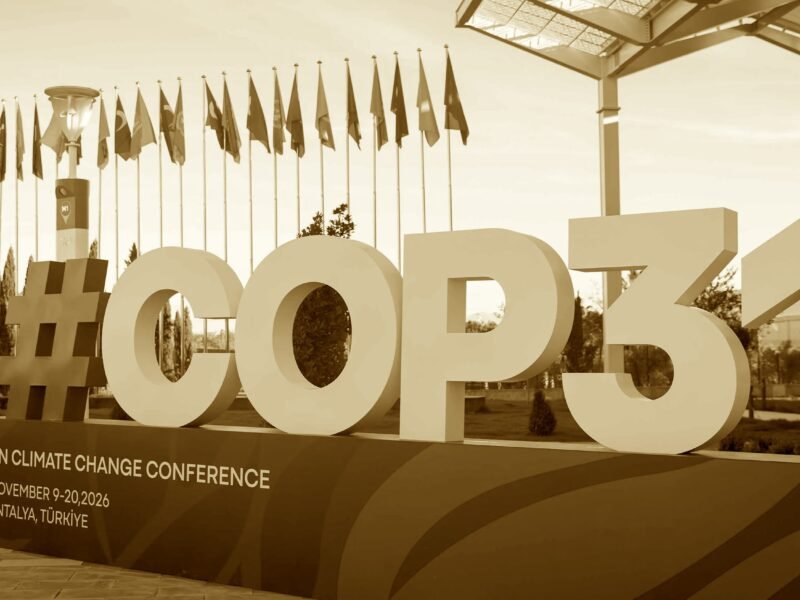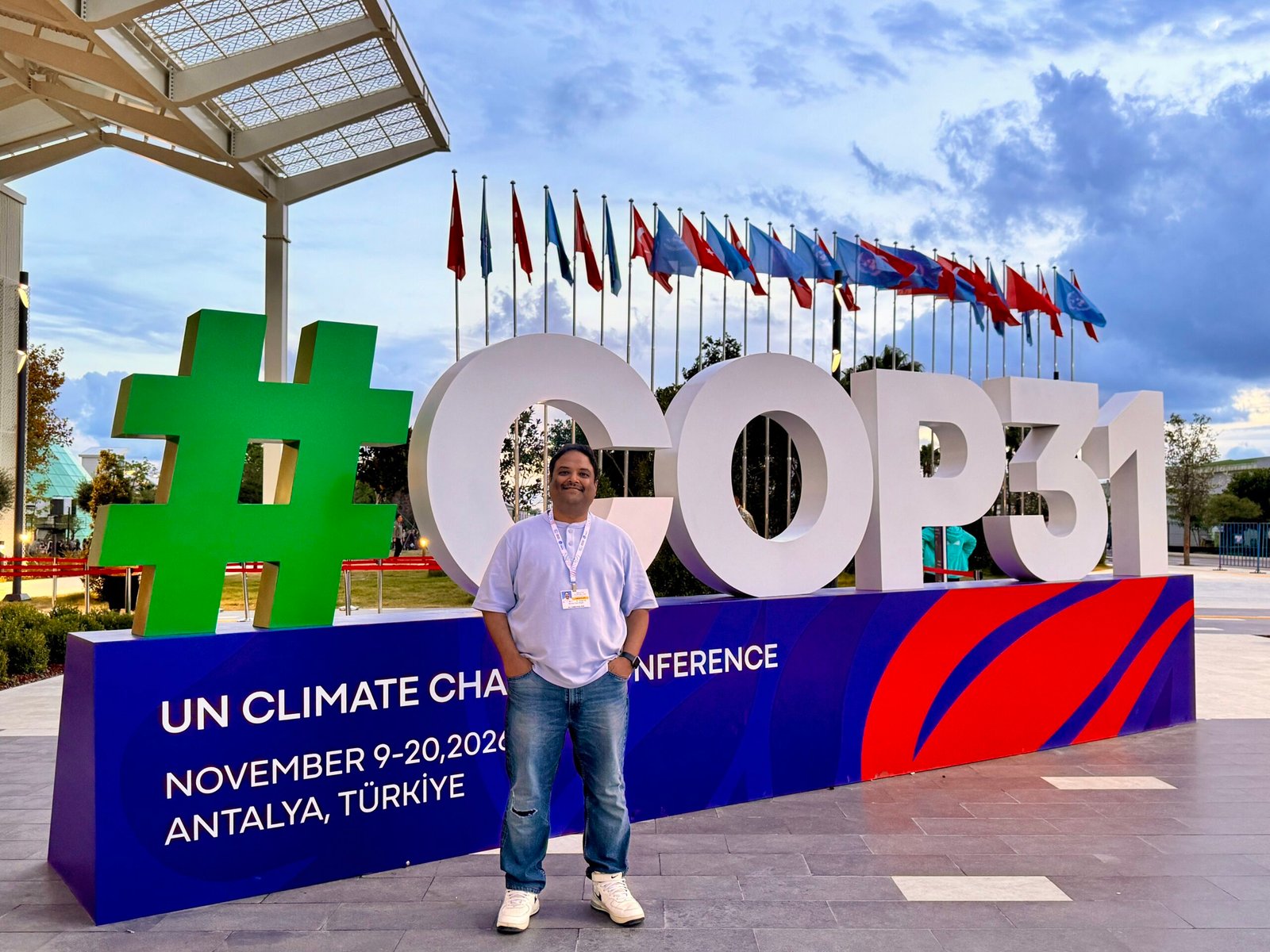
I spent a week at COP31 in Antalya. The negotiations stalled; the conversations didn’t. Here is what was settled, what wasn’t, and what it means for carbon markets and for India.
If you live in Delhi, you know what November feels like. The sky turns a flat grey, your throat catches by evening, and checking the air quality index becomes as routine as checking the weather. Now picture stepping off a plane a few hours later into clear Mediterranean air, with the sea on one side and mountains on the other.
That was Antalya for me, and it was quite literally a breath of fresh air. Good infrastructure, mild weather and clean air meant I walked seven or eight kilometres a day between venues without a second thought. Try doing that in Delhi in November. Every one of those walks was a quiet reminder of what we were all there to negotiate over: not targets and texts, but the air our children breathe.
I came home with two very different notebooks, and I want to share both with you.
The first is full of names, follow-ups and ideas. It comes from the halls, and especially from the Green Pavilion, where I spent more of my time than I expected. The second is thinner. It tracks what the negotiators actually agreed, and most of its pages say “deferred.”
COP31 closed on Sunday 22 November, two days late and more than 50 hours past its scheduled finish. That makes it the longest COP on record. It is also the first since Copenhagen in 2009 to end without an overarching political decision. The Antalya Pact, the cover text the Turkish and Australian presidencies had built all fortnight, never made it through the closing plenary.
Before the summit I wrote that we should lower our expectations on the headline and raise them on the plumbing. The headline did worse than I feared. The plumbing did a little better than the headlines suggest. And the most useful part of the fortnight happened outside the negotiating rooms altogether.
At a glance
- No overarching deal. The Antalya Pact failed, the first COP without a cover decision since Copenhagen in 2009.
- Old promises stand. Paris, the Dubai fossil fuel commitment and the Belém adaptation pledge are all still in place.
- Carbon markets survived. The Article 6 decisions were adopted and the international registry is live, though funding is still unresolved.
- The energy moved outside the talks. Coalitions, national roadmaps and the Green Pavilion did more than the plenary.
- For India, a build year. The rules are settled enough to use. The next twelve months are about systems, not speeches.
How the Antalya Pact fell apart
I was in Antalya from 13 to 19 November, so I saw the first drafts land in person and followed the ending from home. The first full draft of the cover decision, on 16 November, was the most ambitious. It carried language on transitioning away from fossil fuels and a figure of $120 billion for adaptation finance. For a couple of days it looked like it might hold. On 19 November, the day I flew out, a new draft dropped both. By the final version on the 22nd, the text no longer mentioned coal, oil or gas at all, and leaned on carbon capture instead.
That was the breaking point. The EU, the UK, Norway, Panama, the Pacific island states, the Least Developed Countries and the AILAC group refused to sign. Speaking for the EU, Ireland’s minister Darragh O’Brien put it plainly: “We will not endorse a cover decision or an Antalya pact that does not even mention fossil fuels.” Saudi Arabia, for the Arab Group, defended carbon capture as one pathway among several. Tuvalu’s climate minister said it felt like “negotiating with the Saudis.”
Finance split the room along a second line. Developing countries wanted to talk about what developed countries owe under Article 9.1 of the Paris Agreement. Developed countries wanted a broader conversation, and the EU refused to reopen the finance deal struck in Baku. India and the Like-Minded Developing Countries pressed on equity and historical responsibility, and India also objected to the proposed electrification target as a top-down approach.
Chris Bowen, who chaired the negotiations, said the red lines simply could not be bridged. Simon Stiell said consensus had “fallen short.” António Guterres said he was “deeply disappointed.”
I want to be careful here, because “COP fails” is an easy headline and not quite the right one. Nothing agreed before Antalya has been undone. The Paris Agreement stands. The Dubai commitment to transition away from fossil fuels stands. The Belém commitment to triple adaptation finance by 2035 stands. What failed was the attempt to build on them. That is disappointing, but it is not a collapse.
Checking my own predictions
Before I flew out, I put my predictions in writing. If I’m going to ask negotiators to be accountable, I should hold myself to the same standard. So here is my own report card.
| Issue | What I expected | What happened |
|---|---|---|
| Just transition mechanism | Likely on mandate, unlikely on money | Right. A decision on how the mechanism will be designed, with submissions due by 15 March 2027. No new money |
| Mitigation Work Programme | Possible | Wrong. Not renewed, after objections from Russia and Saudi Arabia |
| Fossil fuel roadmap | Unlikely in the text; more likely from a coalition | Right, and worse. The text dropped fossil fuels entirely. At least seven countries, including Germany, France and the Netherlands, have published their own roadmaps |
| $1.3 trillion finance plan | Unlikely. Process, not numbers | Right. The finance work programme continues to 2028, with the Article 9.1 dispute unresolved |
| Adaptation indicators and finance | Possible on indicators, weak on finance | Right. A task force will refine the 59 indicators by COP32. The $120 billion figure vanished from the drafts |
| Article 6.2 registry funding | Likely, though the cheque may be small | Half right. The registry’s first version is live, but there is no permanent funding. The question goes to the June 2027 sessions |
| PACM and CDM transition | Possible | Partly. Four methodologies welcomed and guidance adopted, but no funding fix |
| Agriculture work | Likely | Wrong. Talks collapsed for the second year running and were deferred to Bonn |
| “35 by 35” electrification | Possible, but voluntary | Right. Over 75 countries, including China, signed up outside the negotiated text |
I got most of these right, and I take no pleasure in it. Where I expected process, we got process. Where I hoped for a modest step forward, on mitigation and agriculture, we got nothing. Looking back, my week-one table was a little optimistic.
Carbon markets: the plumbing held, just
This is the part of Antalya I watched most closely, because it is the part I work on every day. And here, I’m glad to say, the news is better than the headlines.
The Article 6 decisions on 6.2, 6.4 and 6.8 were adopted as separate texts, so they survived the collapse of the cover decision. The rulebook was not reopened. The international registry for tracking transfers between countries went live in its first version, which matters more than it sounds. Until now, a tonne moving between two governments had no common place to be recorded.
But the decisions also showed how far there is to go. On the expert reviews that found inconsistencies in every Article 6 report filed so far, the response was an informal dialogue in Bonn next June. On funding the registry, there was no permanent arrangement, only a technical paper and another discussion. On the Paris Agreement Crediting Mechanism, parties welcomed four more methodologies and asked the Supervisory Body to make its framework clearer and more consistent. Developers, through IETA and the Project Developer Forum, argued the rules are still too conservative to bring supply to market.
Outside the formal track, the voluntary market had a better fortnight. Fourteen countries signed the Antalya Statement from the Coalition to Grow Carbon Markets, which also launched a policy playbook. Egypt and Ireland said they would join. Norway and Indonesia signed a deal for up to 12 million tonnes of mitigation outcomes from solar projects over ten years.
My reading is simple. The rules are now settled enough to use. What is missing is the operational layer: funded registries, consistent data and reconciliation that works across systems. That is not a negotiation problem. It is a build problem.
If you work in this market, as a developer, a verifier, a buyer or someone building the technology underneath it, that should feel like an invitation. The next stretch of progress will not come from a plenary hall. It will come from us.
The global picture: consensus has hit its limits
Step back from the texts and the numbers tell the story. National plans for 2035 are expected to bring emissions only about 6% below 2019 levels, or about 9% if every pledge is delivered. Current policies still point to roughly 2.8°C of warming. The loss and damage fund received 176 funding requests from 119 developing countries, worth about $2.8 billion, against $342 million it could allocate. The Adaptation Fund raised $50 million against a target of $300 million a year.
Those gaps explain why the room split the way it did. Around 130 countries wanted the fossil fuel language back. But many developing countries in that group did not object to the weak final text, because for them finance mattered more than words about oil and gas. When the countries most exposed to climate change have to choose between ambition and money, the process has a structural problem, not a drafting one.
I spent three decades building systems for large institutions, and one lesson stuck: a process that needs every single party to agree will eventually move at the pace of its most reluctant member. That is what Antalya looked like. One group of producers could remove a sentence. One bloc could refuse to reopen a finance deal. A two-week summit ran 50 hours over and still ended without a shared text. China said the result should not be read as the collapse of climate multilateralism, and I agree. But it is clearly no longer the only engine of progress.
The other engines were visible in Antalya. Coalitions of the willing on electrification, buildings, waste and AI energy use. National roadmaps published without waiting for a global one. And Türkiye says more than $26 billion in deals and plans were lined up during the summit, though much of that is preliminary. None of it carries the weight of a consensus decision. All of it moves faster.
Where the real work happened
If the plenary was the disappointment of Antalya, the Green Pavilion was the surprise. Honestly, it is what made the trip worth it for me.
I went expecting the usual round of panels and polite card swaps. What I found was a room full of people who had stopped waiting for the negotiations.
Over the week, I met enthusiastic and genuinely lovely people from more than 20 countries, from every point of the compass. Island states that feel every storm. Gulf economies rethinking their future. South Asian neighbours facing the same heat and the same questions we do. Many of the best of those conversations happened right here, in the Green Pavilion.
And the conversations were practical. They were not about what was going wrong. They were about what we can build together to create real value and make this work.
That is the conversation I care about most, and in Antalya it was happening between people with budgets and timelines, not just positions. I came home with a long list of serious collaboration conversations to follow up. Several of them are about exactly the gap this piece keeps returning to: making registries, MRV systems and market data work together.
That contrast is the real lesson of COP31 for me. The negotiators could not agree on a sentence about fossil fuels. Meanwhile, in the Green Pavilion, people were agreeing on pilots, data sharing and next steps. The formal process sets the direction. The market, increasingly, is what actually moves.
What it means for India
India went to Antalya with a clear message. In the national statement, Bhupender Yadav grounded India’s position in equity, climate justice and common but differentiated responsibilities. He said “equitable access to the remaining carbon budget is non-negotiable,” and that COP31’s success would be judged by “tangible implementation.” By that test, India has every reason to be frustrated. The finance questions it cares about most were left for another year.
But I would not read Antalya as a loss for India. Three things work in our favour.
First, the carbon market rules survived intact. Article 6 is now settled enough to plan around, and the international registry is live. India’s job is to make sure its own authorisations, registry and reporting line up cleanly with it. That is entirely within our control.
Second, the action has shifted to coalitions and to markets. That suits a country with India’s scale, its industrial base and its growing pool of projects. We do not need a consensus text to build CCTS well, to develop credible domestic MRV, or to make Indian credits trusted by international buyers.
Third, the voluntary side has room to grow. CCTS gives the compliance market a clear anchor. On the voluntary side, the market will grow faster if clear rules let other credible players contribute alongside the national system. What I saw in the Green Pavilion suggests international partners are ready to work with Indian institutions that can show strong governance and clean data.
The next milestones are close. Just transition submissions are due by 15 March 2027. The Article 6 registry funding and the expert review findings come back at the Bonn sessions in June. And COP32 in Addis Ababa, in November 2027, will have to pick up everything Antalya left on the table. India should treat the next twelve months as a build year, not a waiting year.
The view from here
In my pre-COP piece I wrote that the risk worth watching was “implementation” becoming a polite way of saying “no new commitments.” Antalya went one step further. It produced no new commitments and only a little implementation.
And yet I flew home more optimistic than the headlines would suggest. Partly that was the Mediterranean air. Mostly it was the people. The rules for carbon markets are in place. The registry exists. And the people who will actually make this work, the developers, verifiers, registries, technology providers and buyers, were in Antalya talking to each other with real intent. I was glad to be one of them.
The negotiators will try again in Addis Ababa. In the meantime, the rest of us have a year to build the systems that make their next decision easier to keep. I know where I will be spending mine: following up on every conversation from that pavilion, and turning as many of them as I can into something real before COP32.
So let me end with a question for you. Were you in Antalya, in person or following from afar? What did you see that the headlines missed? And if I have got something wrong or left out something important, please tell me. I followed the final days from home, and I would rather correct this piece than defend it. If you are working on the same problems, making carbon data trusted, connected and counted once, I would genuinely like to hear from you. That is how the work after Antalya begins: one conversation at a time, the same way it did in that pavilion.
Views expressed here are my own and do not represent any organisation I am associated with.
Sources
- COP31 ends without a political deal, but some decisions survive, Climate Action
- COP31: What the failure to reach consensus means for the global climate agenda, Norton Rose Fulbright
- COP31 after the breakdown: final outcomes and the status of the Antalya Pact, Erkan’s Field Diary, 23 November 2026
- Worst. COP. Ever. COP31 ends without a deal, Climate & Capital Media
- COP31 Antalya: what changes for carbon credit buyers, ClimateTrade
- COP31: Key outcomes for food, forests, oceans and nature, Carbon Brief
- India calls for equity, climate justice and fulfilment of climate finance obligations at COP31, All India Radio News, 18 November 2026
- COP31 in Antalya: The Year the Ledger Comes Due, Carbon Market India
Get this in your inbox
I maintain a working reference on India’s carbon market — which CCTS sectors are notified, which are actually operable, how many methodologies and accredited verifiers exist, and where CBAM stands. Subscribe and I will tell you when those facts change. No fixed schedule, and nothing sent for the sake of sending it.